
Every summer the same madness takes over football. A club announces a £100 million signing out of nowhere, fans lose their minds on social media, and within hours the player is holding up a new shirt. But how do football transfers work behind the scenes?
The truth is that a transfer is part business deal, part legal maze, and part high-stakes poker game. Agents, lawyers, doctors, and sporting directors all play their part before a player ever kicks a ball for his new club. This guide breaks down the full process in plain language.
What Actually Happens When a Club Signs a Player
When people ask how do football transfers work, they usually picture two clubs shaking hands on a fee. The reality involves three separate agreements: the buying club and selling club agree a transfer fee, the buying club and the player agree personal terms, and the player passes a medical. All three must be completed before the deal is official.
The transfer fee goes to the selling club, not the player. That is the single most misunderstood part of the whole process. The player gets his wages, a signing bonus, and sometimes a cut of the fee written into his old contract, but the headline £100 million goes from one club’s bank account to another’s.
FIFA’s Transfer Matching System then logs the deal internationally. Both clubs must enter matching details into the system or the transfer cannot be completed. It sounds boring, but this digital paperwork is what makes a transfer legally binding across borders. Read more: La Liga Transfer Window 2026: Every Confirmed Deal
The Transfer Windows: When Deals Can Happen
Clubs cannot sign players whenever they want. FIFA rules allow only two registration windows per year: a long summer window and a short winter window in January. Outside these windows, clubs can agree deals in principle but cannot register new players.
The dates are not identical across leagues, which catches clubs out every year. A club in England might have its window closed while the Saudi Pro League is still open, meaning players can leave but nobody can come in as a replacement. Here are the summer 2026 windows for the top five leagues.
| League | Window Opens | Window Closes |
|---|---|---|
| Premier League | June 15, 2026 | September 1, 2026 |
| Ligue 1 | June 15, 2026 | August 31, 2026 |
| Serie A | June 29, 2026 | September 1, 2026 |
| La Liga | July 1, 2026 | September 1, 2026 |
| Bundesliga | July 1, 2026 | August 31, 2026 |
The January 2026 window ran from January 1 to February 2 for most leagues, with Serie A and La Liga opening a day later on January 2. Winter windows are shorter and usually quieter, since clubs hate selling key players mid-season. The big money almost always moves in summer.
Step by Step: From First Contact to Official Announcement
Understanding how do football transfers work means following the chain of events. It starts with scouting: a club’s recruitment team identifies a target, sometimes tracking him for years. The sporting director then makes contact, usually through the player’s agent rather than directly, because tapping up a player without permission can bring serious punishment.
Next comes the negotiation. The buying club makes an offer to the selling club, which can accept, reject, or counter. This back-and-forth can take weeks. Once the clubs agree a fee, the buying club negotiates personal terms with the player: wages, contract length, bonuses, and image rights.
Then the player flies in for a medical. Club doctors run heart screenings, blood tests, joint assessments, and checks on old injuries. If he passes, the contracts are signed, the paperwork goes to the league and FIFA, and the club posts the announcement video. From first bid to done deal, a big transfer can take anywhere from 48 hours to an entire summer.
The Money: Transfer Fees, Add-Ons and Sell-On Clauses
The headline fee is rarely the full story. Most big deals include add-ons: extra payments triggered by appearances, goals, trophies, or international caps. A £80 million deal might be £60 million up front plus £20 million in add-ons that may never be paid.
Sell-on clauses are where smaller clubs strike gold. When a club sells a young player, it often keeps a percentage of any future transfer fee. Real Madrid earned close to €200 million from academy sell-on clauses in recent years, profiting from players they barely used. Read more: Highest-Paid Footballers 2026: Top 10 Rich List
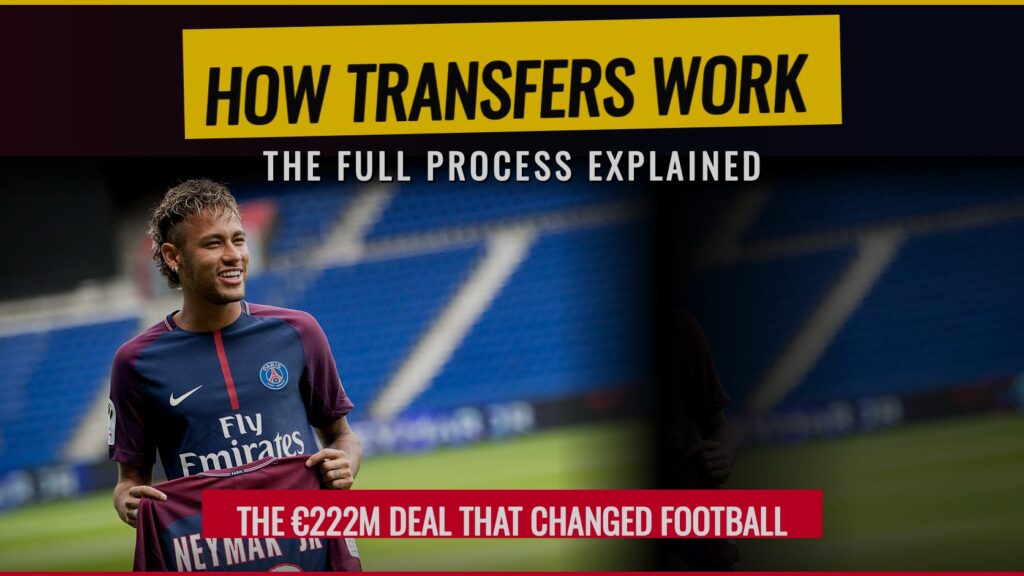
The world record still belongs to Neymar: €222 million from Barcelona to PSG in August 2017. Nearly a decade later, nobody has come close. The next highest is Kylian Mbappe’s €180 million move from Monaco to PSG, and the British record is Moises Caicedo’s £115 million switch from Brighton to Chelsea.
Free Transfers and the Bosman Ruling
Not every transfer involves a fee. When a player’s contract expires, he becomes a free agent and can sign for any club without a transfer fee. This is thanks to the Bosman ruling, a 1995 European court decision named after Belgian footballer Jean-Marc Bosman.
Before Bosman, clubs could demand a fee even for out-of-contract players, which trapped footballers at clubs against their will. The ruling changed everything. It gave players freedom of movement and created the modern free-transfer market.
The most famous recent example is Kylian Mbappe joining Real Madrid for free in 2024 after his PSG contract expired. PSG had paid €180 million for him and got nothing when he left. Players in the final six months of their contracts can even sign pre-contract agreements with foreign clubs, which is why January is open season for summer freebies. Read more: Ballon d’Or 2026: Nominees, Favorites, Date and Everything You Need to Know
Loans: Why Big Clubs Lend Out Their Players
Sometimes a transfer is temporary. In a loan deal, the player joins another club for a season or two while his parent club keeps his registration. The loaning club usually pays part of the wages, and sometimes a loan fee on top.
Big clubs use loans to develop young talent. A 19-year-old cannot get minutes ahead of superstars, so he goes on loan to a smaller club, plays every week, and comes back ready. Chelsea and Manchester City have turned this into an art form, stockpiling dozens of young players and loaning them across Europe.
Loans can also rescue a career. A player frozen out by his manager gets a fresh start without a permanent commitment from either side. And in January, loans are the go-to fix for clubs that need cover for injuries but cannot afford a big permanent signing.
Release Clauses: Football’s Buy-It-Now Button
A release clause is a fixed fee written into a player’s contract. If a buying club offers exactly that amount, the selling club cannot refuse. It is the closest thing football has to a buy-it-now button.
Release clauses are mandatory in Spain, which is why Neymar’s €222 million move happened the way it did. PSG simply paid the clause and Barcelona were powerless to stop it. In England they are optional, and clubs often refuse to include them or set them sky-high to scare off suitors.
The catch is that the player still has to agree. Paying a release clause only forces the selling club’s hand. The player can still say no, pick a different club, or use the bid to negotiate a better contract where he is.
Why Transfers Collapse (Medicals, Agents, Last-Minute Hijacks)
For everyone learning how do football transfers work, the collapsed deals are the most dramatic part. A transfer can fall apart at any stage, and it happens more often than clubs admit. The medical is the most famous deal-killer.
In January 2026, Jean-Philippe Mateta’s £30 million move from Crystal Palace to AC Milan collapsed when Milan’s doctors flagged problems with his right knee. Mateta had surgery on a meniscus injury years earlier, and Milan decided the risk was too high. The deal died on deadline day after everything else was agreed.
Agents can blow up deals too. They earn huge commissions, typically 5 to 10 percent of the transfer fee, and a disagreement over their cut has killed many transfers. Then there are hijacks: one club agrees a deal, and a bigger club swoops in at the last minute with a better offer. The player chooses, the first club is left furious, and fans get a saga to argue about for years. That is how do football transfers work at the sharp end: nothing is done until the paperwork is signed.
When is the football transfer window open?
There are two windows each year. The summer 2026 window ran from mid-June to September 1 for most top European leagues, though exact dates vary by country. The January window typically runs for the whole month, closing in early February.
Who gets the transfer fee, the player or the club?
The transfer fee goes to the selling club, not the player. The player receives wages, a signing bonus, and sometimes a loyalty payment from his old club, but the headline fee moves between the two clubs.
What happens if a player fails a medical?
The buying club can walk away from the deal with no obligation. Sometimes the clubs renegotiate a lower fee to reflect the risk, but often the transfer simply collapses, as happened with Jean-Philippe Mateta’s move to AC Milan in January 2026.
Can a player refuse a transfer?
Yes, absolutely. Even if two clubs agree a fee, the player must agree personal terms and sign the contract. No player can be forced to join a club against his will, which is why agreed deals still collapse when the player changes his mind.
What is the difference between a loan and a permanent transfer?
In a permanent transfer, the buying club pays a fee and owns the player’s registration outright. In a loan, the player temporarily joins another club while his parent club keeps his registration, usually with the loaning club covering some or all of his wages.