
Table of Contents
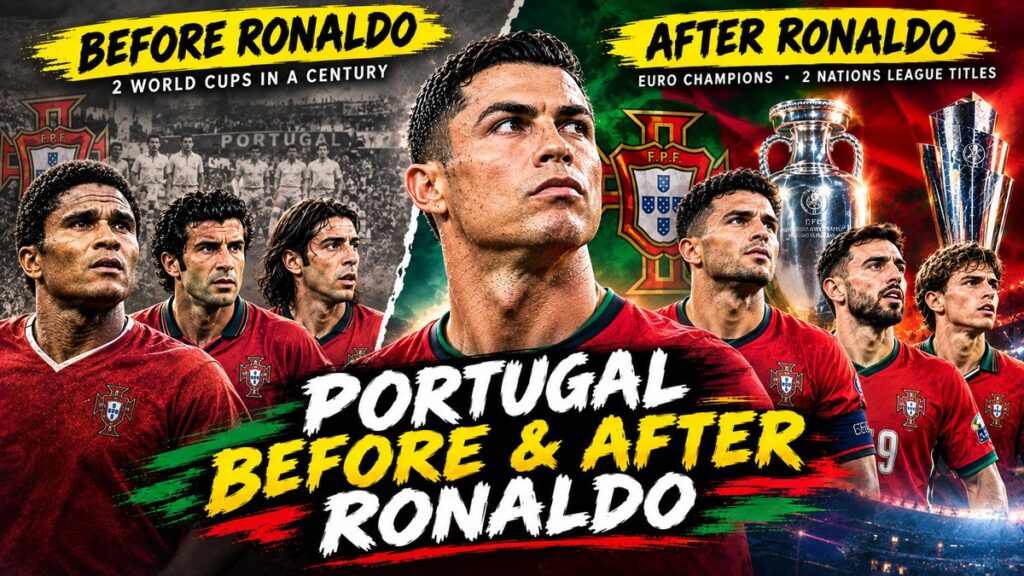
Football nations rarely get a true before-and-after story. Portugal before and after Ronaldo is exactly that: a split so stark it reads like two different national teams entirely.
One version qualified for just two World Cups across an entire century. The other became home to the most capped and highest-scoring player in men’s international football history, a European champion, and a two-time Nations League winner.
Here’s how Portugal actually got from one era to the other.
Quick Reference Table
| Era | Key Results | Defining Names |
| Pre-1990s | 2 World Cup appearances in a century | Eusébio (1966 third place) |
| Golden Generation (1990s-2003) | Euro 2000 semifinal, Euro 2004 final | Luís Figo, Rui Costa |
| Ronaldo Era (2003-2026) | Euro 2016 champions, 2 Nations League titles | Cristiano Ronaldo, Bruno Fernandes |
| Post-Ronaldo (2026-) | Jorge Jesus rebuild begins | Gonçalo Ramos, João Neves |
Portugal Before Ronaldo, A Nation Still Finding Itself
For most of the 20th century, Portugal simply wasn’t a footballing power.
The country qualified for just two World Cups in a hundred years. Eusébio’s 1966 campaign, ending in third place with the tournament’s Golden Boot in his pocket, stood alone as a genuine highlight for decades.
Everything changed with the mid-90s Golden Generation. Luís Figo, Rui Costa, Vítor Baía, and João Pinto had already won back-to-back Under-20 World Cups before cracking the senior setup.
That generation dragged Portugal into relevance. A Euro 2000 semifinal loss to France on a Zidane golden-goal penalty hurt, but it proved Portugal belonged.
Four years later, hosting Euro 2004 on home soil, that same core reached the final, only to lose 1-0 to a stunning Greek side nobody saw coming.
Enter Ronaldo: A Teenager Walks Into History
Cristiano Ronaldo made his senior Portugal debut on August 20, 2003, in a friendly against Kazakhstan. He was 18, fresh off a move to Manchester United, and largely unknown outside Portuguese football circles.
He didn’t inherit a blank slate. The Golden Generation’s dressing room shaped him from day one, and he played a role in that Euro 2004 run as a teenager alongside Figo and Rui Costa.
By 2006, Ronaldo was a key piece of the squad that reached the World Cup semifinal, Portugal’s best finish since Eusébio’s bronze in 1966.
The captaincy came in 2008, and from that point, Portugal before and after Ronaldo stopped being a comparison and became a complete transformation.
World Cup Qualifying, The Numbers Behind the Myth
Some argue World Cup qualification is routine for a country like Portugal, just a formality before the real tournament begins. Italy’s recent history says otherwise.
| Stat | Ronaldo / Portugal |
| All-time top scorer, World Cup qualifying | 41 goals |
| Next closest (Carlos Ruiz) | 39 goals |
| Messi’s qualifying goals | 36 goals |
| Consecutive World Cups qualified (Ronaldo era) | 6 (2006-2026) |
| Portugal’s World Cup appearances before Ronaldo (entire 20th century) | Just 3 (1966, 1986, 2002) |
| Nation | World Cups Won | Recent Qualification Struggles |
| Portugal (Ronaldo era) | 0 | None, 6 straight qualifications |
| Italy | 4 | Missed 2018 and 2022 World Cups |
Four-time world champions, and still Italy couldn’t find a way through two separate qualifying campaigns. That’s the real context behind Portugal’s six straight appearances under Ronaldo, a run built on far more than talent simply showing up when it mattered.
The Portugal before and after Ronaldo gap becomes impossible to ignore once you see it laid out like that. A country that once treated World Cup qualification as a coin flip turned into one of Europe’s most reliable ever-presents.
The Euro Legacy, Records Nobody Else Comes Close To
Ronaldo’s impact on the European Championship runs even deeper than the World Cup numbers.
He holds the record for most goals in Euros history with 14 in the final tournament stage alone, well clear of anyone else who has ever played the competition. He also appeared in a record five editions, with 25 matches and 2,155 minutes played, both all-time highs.
He remains the only player to score in five separate European Championship tournaments, and the only man to score at least three goals in three different editions of the competition.
Perhaps the most telling stat sits quietly inside the trophy itself. Ronaldo went off injured early in the Euro 2016 final, and still captained Portugal to their first ever major title from the touchline, in tears, refusing to leave his teammates alone.
Nations League, Building a Second Trophy Cabinet
Portugal’s second major trophy arrived through a competition that didn’t even exist when Ronaldo made his debut.
He captained Portugal to the inaugural UEFA Nations League title in 2019, on home soil, then added a second Nations League crown in 2025. Across the competition, he scored 15 goals, including a go-ahead goal in the very first Nations League Finals back in 2019.
This is where the Portugal before and after Ronaldo story turns from individual brilliance into genuine team-building. Two trophies in two different decades, with largely different squads around him each time, points to something bigger than one man’s talent alone.
The Mentality That Shaped a Generation
Numbers only tell part of this story. What changed Portugal’s dressing room culture was harder to measure but just as real.
At 39 years old, still chasing new records, Ronaldo put it plainly: “It’s going to be quite difficult to reach 1,000 goals but it’s about how I am mentally, my motivation.”
That mindset didn’t stay contained to one player. Younger squad members like Vitinha, João Neves, and Gonçalo Ramos grew up watching a 40-year-old outwork players half his age in training, week after week, tournament after tournament. That standard became the baseline, not the exception.
What Comes After
Portugal now stands at the start of a genuinely new chapter, one shaped by Jorge Jesus rather than built around a single superstar.
Recent weeks have made that transition messier than anyone expected, with tension between Jesus and Ronaldo spilling into public view before the Denmark fixture.
Read more: the Portugal vs Denmark bench row
Whatever happens next, Portugal before and after Ronaldo will remain one of the clearest case studies in modern football of how one player can reshape an entire nation’s trajectory.
Conclusion
Two decades ago, Portugal was a country still trying to prove it belonged among football’s elite. Today it’s a nation with a European Championship, back-to-back Nations League titles, and the record books rewritten in World Cup qualifying, Euros, and beyond. Read more: Portugal’s road to the 2026 final
That shift didn’t happen by accident, and understanding Portugal before and after Ronaldo means understanding just how rare it is for one era to so completely define a football nation’s identity.
Read More: Top 10 Greatest Footballers of All Time In Football History
FAQs:
How did Portugal perform before Cristiano Ronaldo’s debut?
Before Ronaldo, Portugal had qualified for only two World Cups in a century, with their best result being third place in 1966 behind Eusébio.
When did Cristiano Ronaldo make his Portugal debut?
Cristiano Ronaldo debuted for Portugal on August 20, 2003, in a friendly against Kazakhstan at the age of 18.
What was Portugal’s first major trophy in the Ronaldo era?
Portugal won their first major trophy at Euro 2016, beating France in the final despite Ronaldo going off injured early in the match.
How many World Cups did Ronaldo help Portugal qualify for?
Comparing Portugal before and after Ronaldo shows a clear shift, with the team qualifying for six consecutive World Cups from 2006 to 2026 during his career.
How many caps and goals did Ronaldo finish with for Portugal?
Cristiano Ronaldo finished his Portugal career with 234 caps and 146 goals, both senior men’s international records.